What is Bikram Sambat? A Complete Guide to Nepal’s Official Calendar System
If you’ve ever wondered what is Bikram Sambat or why Nepal follows a different calendar system than most of the world, you’re not alone. This ancient calendar system is deeply woven into Nepali culture, traditions, and daily life, making it essential knowledge for anyone living in or connected to Nepal.
Whether you’re a Nepali living abroad trying to fill out official documents, a student preparing for exams, or simply curious about this fascinating calendar system, this comprehensive guide will answer all your questions about Bikram Sambat and its significance in Nepali society.
What is Bikram Sambat? Understanding Nepal’s Calendar System
Bikram Sambat (BS) is the official calendar system used in Nepal, named after the legendary King Vikramaditya. This lunar-solar calendar is approximately 56 years and 8-9 months ahead of the Gregorian calendar (AD) that most of the world uses today.
For example, when it’s 2024 AD in the Gregorian calendar, it corresponds to 2080-2081 BS in the Bikram Sambat system. This difference might seem confusing at first, but once you understand the system, converting between BS to AD and AD to BS becomes straightforward.
The Nepali calendar follows a unique structure where months have varying numbers of days, unlike the Gregorian calendar’s more standardized approach. Some months in Bikram Sambat have 29 days, others have 30, and some can have up to 32 days, depending on astronomical calculations and lunar cycles.
The Rich History and Origin of Bikram Sambat
Understanding the history of Bikram Sambat takes us back over two millennia. The calendar system was established around 57 BCE by King Vikramaditya of Ujjain, a legendary ruler known for his wisdom, valor, and patronage of arts and sciences.
According to historical accounts, King Vikramaditya created this calendar to commemorate his victory over the Shakas, a group of invaders from Central Asia. The calendar was initially called “Vikrama Samvat” and was widely used across the Indian subcontinent before the adoption of other calendar systems.
In Nepal, Bikram Sambat gained official status and has been continuously used for centuries. Unlike many other regions that eventually adopted the Gregorian calendar for official purposes, Nepal maintained its traditional calendar system, making it one of the few countries in the world to use a non-Gregorian calendar as its official dating system.
The calendar’s astronomical basis makes it particularly accurate for agricultural societies. Ancient Nepali farmers relied on this calendar to determine the best times for planting, harvesting, and conducting religious ceremonies, a practice that continues in many rural areas today.
Bikram Sambat vs Gregorian Calendar: Key Differences
When comparing Gregorian calendar vs Bikram Sambat, several fundamental differences become apparent that go beyond just the year count.
Year Structure and Length
The Bikram Sambat year begins in mid-April according to the Gregorian calendar, typically around April 13-15. This marks the beginning of the month of Baishakh, which is also when Nepal celebrates its New Year. In contrast, the Gregorian year starts on January 1st.
A Bikram Sambat year consists of 12 months, just like the Gregorian calendar, but the month lengths vary significantly. While Gregorian months have 28-31 days in a predictable pattern, Bikram Sambat months can range from 29 to 32 days, with the exact number determined by complex astronomical calculations.
Month Names and Seasons
The months in the Nepali calendar have distinct names that reflect seasonal changes in the Himalayan region:
- Baishakh (April-May): Spring season begins
- Jestha (May-June): Late spring to early summer
- Ashadh (June-July): Monsoon season starts
- Shrawan (July-August): Peak monsoon
- Bhadra (August-September): Late monsoon
- Ashwin (September-October): Post-monsoon, festival season
- Kartik (October-November): Autumn, major festivals
- Mangsir (November-December): Late autumn
- Poush (December-January): Winter begins
- Magh (January-February): Peak winter
- Falgun (February-March): Late winter
- Chaitra (March-April): Spring preparation
Calculation Methods
While the Gregorian calendar follows a purely solar system with leap years every four years, Bikram Sambat uses a lunisolar system. This means it considers both the sun’s and moon’s positions, making it more complex but also more aligned with natural astronomical phenomena.
Why Nepal Uses Bikram Sambat as the Official Calendar
The decision to maintain Bikram Sambat as Nepal’s official calendar stems from deep cultural, religious, and practical reasons that reflect the country’s commitment to preserving its unique identity.
Cultural Preservation
Nepal has always prided itself on being one of the few countries never colonized by European powers. This independence allowed Nepal to maintain its traditional systems, including the Bikram Sambat calendar, without external pressure to adopt Western systems.
The calendar system is intrinsically linked to Nepali and Hindu cultural practices. Most religious observances, festivals, and rituals are calculated according to Bikram Sambat, making it impossible to separate the calendar from the cultural fabric of Nepali society.
Agricultural Relevance
Nepal’s economy has historically been agriculture-based, and Bikram Sambat aligns closely with the agricultural seasons of the Himalayan region. Farmers use this calendar to determine optimal times for various farming activities, from sowing seeds to harvesting crops.
The calendar’s lunar aspects are particularly useful for agricultural timing, as many farming practices traditionally follow lunar cycles for optimal results.
Religious Significance
Hindu and Buddhist religious observances in Nepal are calculated using Bikram Sambat. Major festivals like Dashain, Tihar, Holi, and Buddha Jayanti are determined by specific dates in the Bikram Sambat calendar, often corresponding to particular lunar phases or astronomical events.
Changing to a different calendar system would disrupt these religious observances and require massive cultural adjustments that most Nepalis would find unacceptable.
The Importance of Bikram Sambat in Nepali Culture and Daily Life
The role of Bikram Sambat extends far beyond simple date-keeping. It’s deeply embedded in Nepali festivals and calendar celebrations, personal milestones, and social customs that define Nepali identity.
Festival Celebrations
Nepali festivals are intrinsically tied to specific dates in Bikram Sambat. Dashain, Nepal’s biggest festival, falls in Ashwin month, while Tihar follows shortly after in Kartik. These festivals don’t have fixed dates in the Gregorian calendar but occur on specific days of specific months in Bikram Sambat.
The Nepali New Year, celebrated on 1st Baishakh, is a major national holiday. Unlike the Gregorian New Year, which falls in the middle of winter in Nepal, the Nepali New Year coincides with spring, symbolizing renewal and new beginnings in harmony with nature.
Personal and Social Events
Nepali people often remember and celebrate personal milestones according to Bikram Sambat dates. Birthdays, wedding anniversaries, and death anniversaries are commonly observed according to the Nepali calendar, especially in traditional families.
Marriage dates are carefully chosen according to Bikram Sambat astrological calculations, and many families consult traditional calendars to select auspicious dates for important events.
Educational and Professional Context
Nepal’s educational system operates on a Bikram Sambat calendar. The academic year begins in Shrawan (July-August) and follows the traditional calendar for holidays and examinations. Understanding Bikram Sambat is therefore essential for anyone involved in Nepal’s education system.
Government offices, banks, and most official institutions in Nepal operate according to Bikram Sambat for holidays and official date-keeping, though they may use Gregorian dates for international correspondence.
How to Convert BS to AD and AD to BS: A Practical Guide
Converting between Bikram Sambat and Gregorian dates is a common need for Nepalis, especially those living abroad or dealing with international documentation. Understanding how to perform BS to AD and AD to BS conversions is essential in today’s interconnected world.
Manual Conversion Methods
The basic principle for converting Nepali Date Converter calculations involves understanding that Bikram Sambat is approximately 56 years and 8-9 months ahead of the Gregorian calendar. However, manual conversion can be tricky due to varying month lengths and the different start dates of years in both systems.
For quick estimates:
- To convert BS to AD: Subtract 56-57 years
- To convert AD to BS: Add 56-57 years
However, for exact conversions, you need to account for the specific month and day, which requires detailed knowledge of both calendar systems.
Digital Conversion Tools
Modern technology has made date conversion much easier. Nepali Date Converter tools available online can instantly convert dates between both systems with perfect accuracy. These tools account for all the complex calculations, including varying month lengths and leap years.
Reliable conversion tools like Miti Converter provide instant, accurate conversions for any date in either calendar system. These tools are particularly useful for:
- Filling out official documents
- Planning international travel
- Coordinating with global teams
- Academic and research purposes
Mobile Applications and Websites
Several mobile apps and websites offer comprehensive date conversion services. The best tools not only convert dates but also provide additional information like day of the week, zodiac signs, and even astrological details that many Nepalis find useful.
When choosing a Nepali Date Converter, look for tools that are regularly updated and provide accurate conversions for both historical and future dates.
Practical Applications: When You Need Date Conversion
Understanding when and how to use date conversion is crucial for modern Nepalis navigating between traditional and international systems.
Official Documentation
One of the most common needs for date conversion occurs when filling out official documents. Passport applications, visa forms, educational certificates, and employment documents often require dates in Gregorian format, while your original documents might be in Bikram Sambat.
For example, if your birth certificate shows your birth date as 15 Chaitra 2050 BS, you would need to convert this to the corresponding Gregorian date (approximately March 28, 1994 AD) for international applications.
Educational Purposes
Students applying to international universities or participating in global programs often need to convert their academic records from Bikram Sambat to Gregorian dates. This includes admission dates, graduation dates, and examination schedules.
Similarly, international students coming to Nepal need to understand the Bikram Sambat system to align with Nepal’s academic calendar and festival schedules.
Business and Professional Context
Nepali businesses operating internationally frequently need to convert dates for contracts, correspondence, and scheduling. Understanding both calendar systems helps in maintaining professional relationships and meeting international deadlines.
Project timelines, delivery schedules, and financial reporting often require coordination between both calendar systems, making date conversion skills valuable in the business world.
Cultural and Social Events
Planning weddings, festivals, and family gatherings often involves coordinating between family members using different calendar systems. Elderly family members might refer to Bikram Sambat dates, while younger generations or those living abroad might be more familiar with Gregorian dates.
Religious observances and cultural celebrations require precise Bikram Sambat dates, but sharing these events with international friends or colleagues might require Gregorian date conversions.
Understanding Nepali Months and Their Cultural Significance
Each month in the Bikram Sambat calendar carries unique cultural, religious, and agricultural significance that reflects Nepal’s rich traditions and natural rhythms.
Baishakh: The Month of New Beginnings
Baishakh marks the beginning of the Nepali year and is associated with new beginnings, growth, and renewal. This month sees the celebration of various festivals including Buddha Jayanti and marks the start of the planting season in many parts of Nepal.
Shrawan: The Holy Month
Shrawan is considered one of the most auspicious months in the Nepali calendar. Devotees observe various fasts and make pilgrimages to holy sites, particularly Shiva temples. The famous Bol Bom pilgrimage occurs during this month, drawing thousands of devotees to sacred sites.
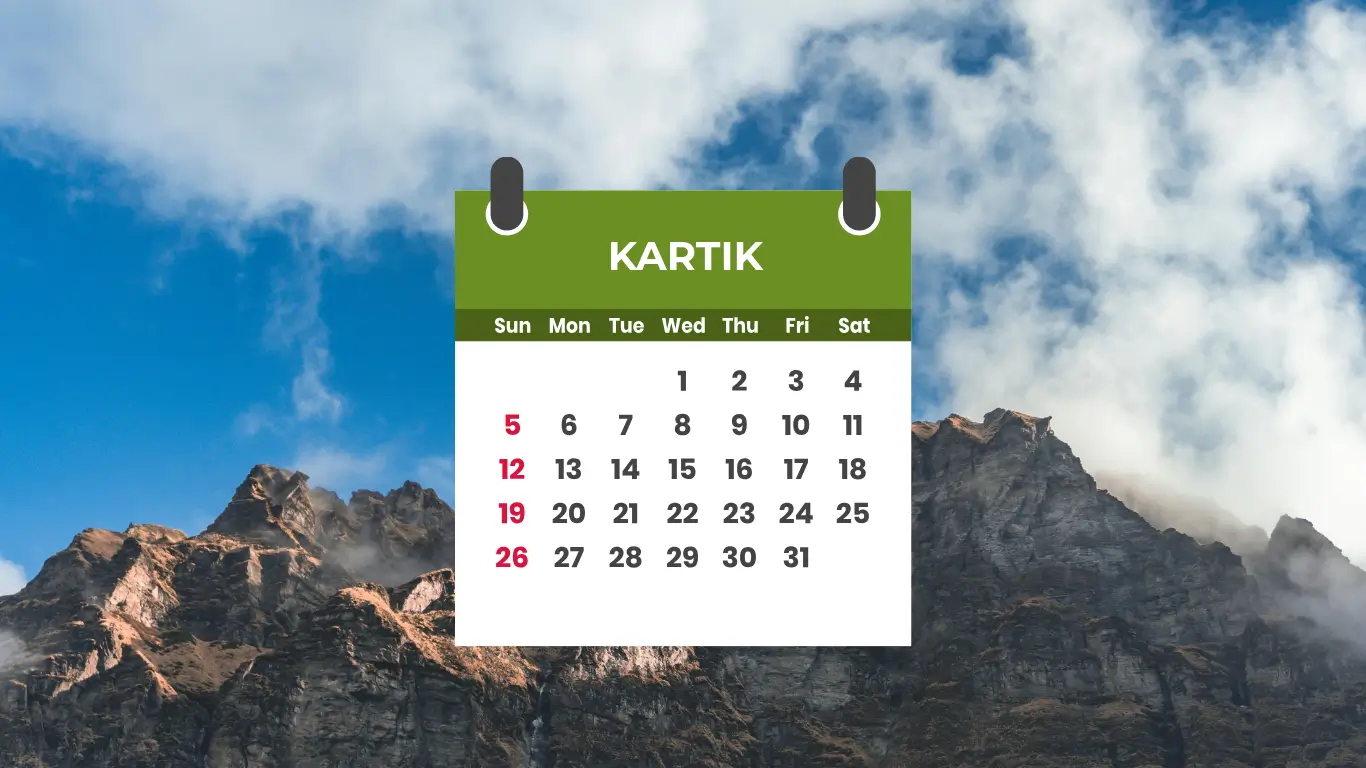
Kartik: The Festival Season
Kartik is perhaps the most festival-rich month in the Nepali calendar. Dashain, the biggest Nepali festival, typically falls in late Ashwin and early Kartik, followed by Tihar, the second-largest festival. This month is also associated with post-harvest celebrations and gratitude.
Frequently Asked Questions About Bikram Sambat
1. What is Bikram Sambat and why is it used in Nepal?
Bikram Sambat is Nepal’s official calendar system, approximately 56-57 years ahead of the Gregorian calendar. Nepal uses this traditional lunisolar calendar to preserve its cultural heritage, align with religious observances, and maintain agricultural traditions that have been followed for centuries.
2. How do I convert Bikram Sambat to Gregorian dates?
To convert BS to AD, you can use online Nepali Date Converter tools for accurate results. For quick estimates, subtract 56-57 years from the Bikram Sambat year, but exact conversion requires accounting for different month lengths and year start dates. Digital tools provide the most accurate conversions.
3. Why is Bikram Sambat ahead of the Gregorian calendar?
Bikram Sambat is ahead because it was established around 57 BCE, while the Gregorian calendar counts from 1 AD. The approximately 56-year difference reflects this historical starting point difference, though the exact gap varies slightly due to different year lengths and starting dates.
4. What are the main differences between Nepali and English months?
Nepali calendar months have varying lengths (29-32 days) compared to the more standardized Gregorian months (28-31 days). Nepali months also start at different times – the Nepali New Year begins in mid-April, and month names reflect seasonal changes specific to the Himalayan region.
5. Do I need to know Bikram Sambat if I’m living outside Nepal?
Yes, understanding Bikram Sambat is helpful for Nepalis abroad for several reasons: filling out official documents that reference your original certificates, participating in cultural and religious celebrations, communicating with family in Nepal, and maintaining connection with Nepali traditions and festivals.
6. How accurate are online Nepali date converters?
Reputable Nepali Date Converter tools are highly accurate as they use official astronomical data and government-approved conversion algorithms. However, it’s important to use reliable sources like established websites that regularly update their databases and calculation methods.
7. Can I use Bikram Sambat dates on international documents?
Generally, international documents require Gregorian dates, but you should include both dates when possible for clarity. For official purposes like visa applications or academic transcripts, convert your Bikram Sambat dates to Gregorian format using reliable conversion tools.
Conclusion: Embracing Nepal’s Timeless Calendar Tradition
Understanding what is Bikram Sambat opens a window into Nepal’s rich cultural heritage and practical daily life. This ancient calendar system represents more than just a way to count days – it embodies Nepal’s unique identity, agricultural wisdom, and spiritual traditions that have endured for over two millennia.
Whether you’re planning to celebrate Nepali festivals, fill out important documents, or simply want to stay connected with your cultural roots, familiarity with the Bikram Sambat system is invaluable. The calendar’s integration with Nepal’s seasonal patterns, religious observances, and social customs makes it an essential part of understanding Nepali culture.
For those frequently needing to convert between calendar systems, reliable tools like Miti Converter make the process effortless and accurate. These Nepali Date Converter resources bridge the gap between traditional and modern needs, helping Nepalis worldwide navigate both calendar systems with confidence.
As Nepal continues to engage with the global community while preserving its unique traditions, the Bikram Sambat calendar stands as a beautiful example of how ancient wisdom can coexist with modern needs. By understanding and appreciating this calendar system, we not only solve practical conversion needs but also honor the rich legacy of Nepali civilization.
Ready to convert your dates accurately? Try our comprehensive Nepali Date Converter tool to seamlessly switch between Bikram Sambat and Gregorian calendars, and explore other useful tools like the Nepali Age Calculator and Nepali Calendar for all your date-related needs.